As the Illinois Quantum and Microelectronics Park (IQMP) rises on Chicago’s South Side, Illinois continues to cement its position as a global leader in quantum innovation. An important aspect of that is the work of our institutions of higher education, an essential part of the state’s expanding ecosystem. Local colleges and universities are playing a pivotal role in partnering with the IQMP to build the workforce, research capacity and talent pipeline needed to sustain the quantum industry’s long-term growth.
Quantum on Campus is the newest series on Quantum State Stories, showcasing the institutions, educators and students shaping the future of quantum and advanced manufacturing in Illinois. We’re highlighting emerging career pathways, innovative workforce programs and strategic partnerships that are designed to ensure opportunities in this rapidly growing industry are accessible to all.
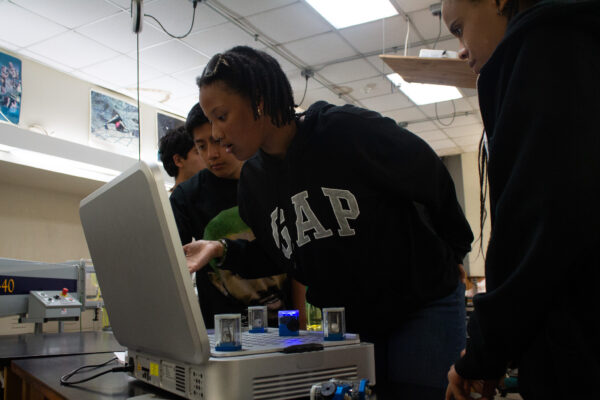
We’re launching our series by taking a look at new quantum and semiconductor workforce degree and certificate programs at Chicago State University. In January, CSU announced their Quantum Information Science & Engineering (QISE) Minor and Certificate, and the Semiconductor Technology and Manufacturing Certificate, becoming the first Illinois public university to offer IBHE-certified quantum and semiconductor programs with flexible pathways in emerging technology fields for degree-seekers, career-changers and current workers alike.
Graduates from these programs will be prepared for careers spanning quantum computing, microelectronics fabrication, advanced manufacturing, data science and more. So far, CSU has engaged nearly 50 students in its quantum programs and awarded its first certificate this past May.
“The future of quantum computing depends not only on technological breakthroughs, but on developing the talent needed to bring those breakthroughs to scale,” said CSU President Z Scott. “At Chicago State University, we are investing in quantum and semiconductor education to prepare the next generation of innovators, engineers, and technical leaders. By expanding access to these emerging fields and aligning education with industry needs, we are helping build a workforce that will drive innovation, strengthen U.S. competitiveness, and ensure the benefits of the quantum economy are broadly shared.”
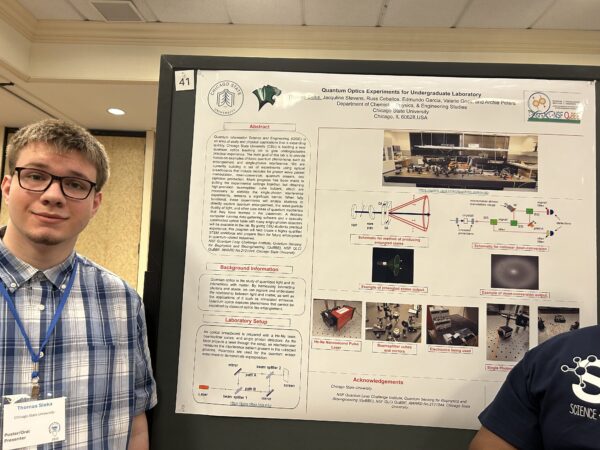
These new offerings build on years of work at CSU to expand access to quantum education and research opportunities. According to Dr. Valerie Goss, Director of CSU’s Quantum Education, Science & Technology Center (CQuEST), the university began exploring experimental quantum research in 2017 and hundreds of students have expressed interest in the years since.
“Once the IQMP came into our area with support at the state level – and from many other companies and institutions – it made perfect sense for us to provide an avenue for our students to be involved,” Dr. Goss said.
By aligning its curriculum with the workforce needs of the emerging quantum and microelectronics industries, CSU is helping create direct pathways for students into the region’s growing quantum economy, anchored by the IQMP. Students now have access to cutting-edge research opportunities, hands-on laboratory experience and valuable connections that can help launch future careers in the field.
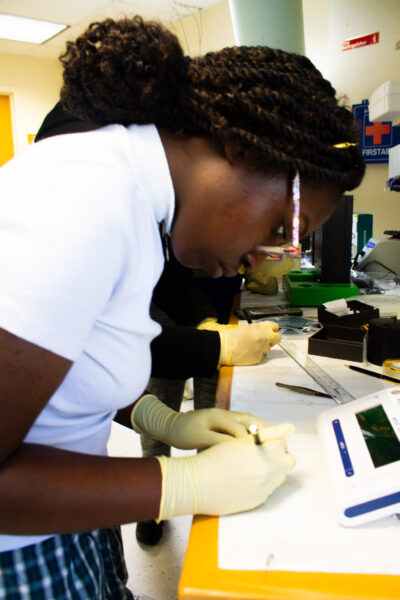
“Hands-on experience in experimentation and lab work is going to be critical for the quantum field,” Dr. Goss said. “It can provide a steppingstone for further degrees.”
The university’s semiconductor certificate similarly emphasizes applied learning. Students receive hands-on training through electronics coursework, laboratory experience and faculty-led research opportunities.
The programs are structured to encourage people from all walks of life to consider a career in the quantum space. CSU students can earn certificates alongside their degree programs, while adult learners and individuals with prior STEM backgrounds can pursue standalone credentials. Students who need additional prerequisite coursework can also complete those requirements through CSU before entering the programs.
“Generally, students who are looking at this have a bachelor’s degree already,” Dr. Goss said. “If they don’t, CSU can make sure we provide the pathway to get there.”
Quadri Durojaiye earned his QISE certificate in the spring and quickly landed a job at Pfizer in the Analytical Research and Development Division.
“While completing the quantum certificate at Chicago State, I gained a deeper understanding of the applications of quantum mechanics, particularly at its intersection with biology,” Durojaiye said. “I applied this knowledge in my research, where I synthesized liposomes to be used for in vitro studies with prostate cancer cell lines in the future. I will utilize what I learned in my current role at Pfizer.”
In March, CSU launched the Quantum Education Science and Technology Center (CQuEST), a centralized office on campus that brings together a network of faculty, staff and students for research and collaboration. The university also actively participates in national and state quantum initiatives.
Dr. Goss said it’s critically important that higher education institutions engage students from under-resourced communities in STEM careers to help them see themselves as part of the field’s future: “They need to see that there are opportunities for them. Not just science students, but students from all majors. There is a place for everyone in the quantum ecosystem.”
CSU is the only Predominantly Black Institution in the National Science Foundation’s (NSF) Quantum Leap Challenge Institute for Quantum Sensing for Biophysics and Bioengineering (QuBBE). The university also received a $700,000 NSF award to help create a national undergraduate quantum curriculum through the Quantum Information Science, Technology, Engineering, Arts and Mathematics Initiative (QuSTEAM).
As Illinois continues building momentum around quantum technology through projects like the IQMP, Dr. Goss believes CSU students and the broader South Side community will be part of shaping what comes next.
“People often use Silicon Valley as an example,” Dr. Goss said. “But perhaps Illinois can be the ‘QTech Valley’ as quantum technology develops everywhere across the prairie’s horizon. I think there’s an opportunity for us to be leaders, and I want to see students doing everything at all levels in this space.”