Chicago Teachers Prepare Themselves, Students for a Quantum Future
With construction of the Illinois Quantum and Microelectronics Park (IQMP) under way on Chicago’s Southeast Side, local teachers are gearing up to incorporate quantum concepts into their lesson plans.
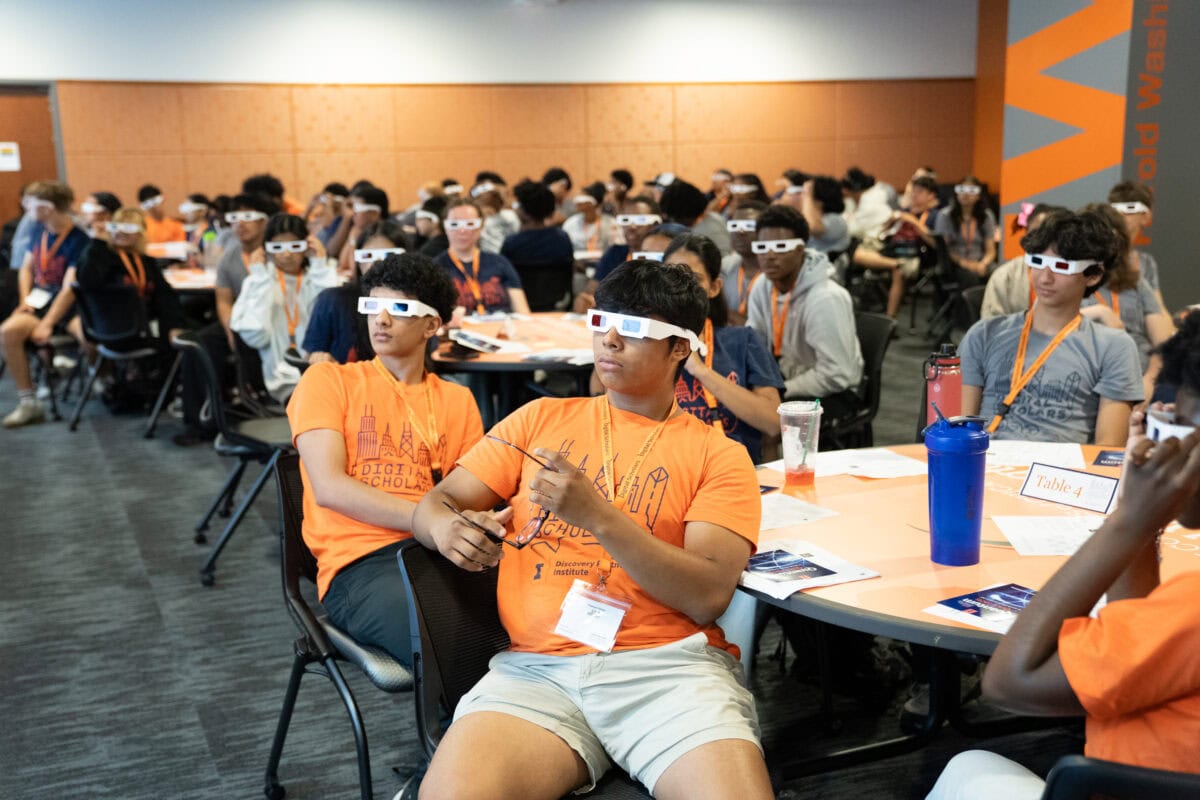
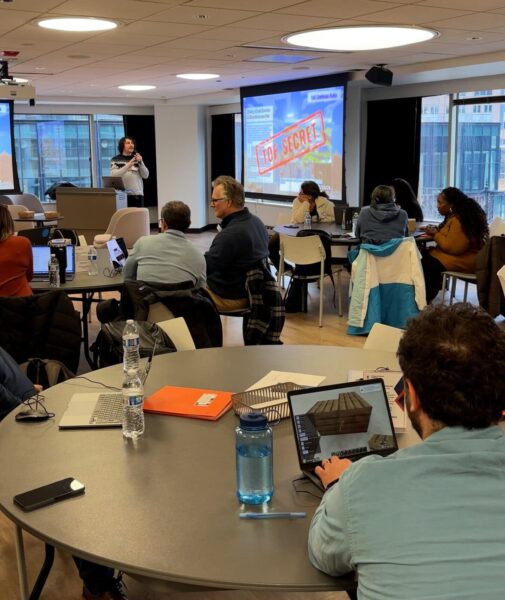
In February, the Discovery Partners Institute (DPI) hosted an introduction-to-quantum workshop for nearly 70 Chicago Public Schools (CPS) teachers eager to help their students engage with emerging technology. Throughout the day, teachers met with school district leaders and university researchers to learn how quantum science will shape technology and industry for years to come. From photonic light experiments to a Minecraft challenge, teachers were given opportunities to explore the technology for themselves.
“What we really wanted to do was demystify what quantum is,” said Danna Dotson, DPI’s associate director of teacher training. “I think teachers took away core concepts about what it is at a global level.”
In partnership with the IQMP, DPI will host more of these experiential sessions, including two-week summer intensives that pair teachers and students together. It’s all part of the IQMP’s effort to educate young people and ensure today’s students are prepared for the quantum jobs of tomorrow.
“The IQMP is a major inflection point for the region,” Dotson said. “When an emerging technology begins to take shape, teachers should be included early. From the child in kindergarten to the high school senior, there must be a pathway of learning.”
Read on to find out why teachers are excited to introduce quantum concepts to their students—and why this material matters now.
“It’s not theoretical anymore”
Adam Davenport is head of the Science Department at James H. Bowen High School, which sits less than a mile from the IQMP. Already, he’s started integrating quantum concepts into their physics curriculum.
“It’s not a theoretical thing for us anymore. It’s the lived reality of the students, and they’re excited to know the bleeding edge of science, which is what quantum is.”
For the past five years, Davenport has been a fellow in the Teach Quantum program at the Pritzker School of Molecular Engineering at the University of Chicago. Every year, he collaborates with university researchers to write a new quantum-based lesson.
“The people who are in the laboratories doing the work are so excited to talk about what they do. I get to learn along with my students, who are excited to know the newest thing.”
Davenport added that if he can’t connect a lesson to students’ real lives or futures, he questions whether it belongs in his curriculum. Quantum passes that test easily.
“My hope is that we will all continue to work in partnership to ensure that the outcomes are not only sustainable but also positive for everybody in our community.”
“This is going to be a lifeline”
For Lane Tech College Prep’s Jenny Roscoe, quantum has transformed from a vague Google search to a future-focused learning opportunity. Jenny arrived at DPI with only a basic idea of the subject, but by the end of the workshop, she could explain how components like entanglement, photons, wavelength, and particles play a role.
For her, quantum isn’t a “nice-to-have” enrichment, it’s part of a long-term economic and career pipeline for Chicago’s youth.
“They’re gonna live here, they’re gonna work here. They can benefit from it, and this isn’t going to just be a short-term project. This is going to be a lifeline for them.”
“[Students] shouldn’t be afraid of it – they should jump right in”
CPS’s Director of Computer Science Kris Beck sees herself as a bridge, connecting emerging technologies to classrooms, teachers and students.
Reflecting on DPI’s event, she spoke about how helpful it is to be in the same room as university researchers, IQMP partners and classroom teachers.
“It helps me to know the type of questions teachers are asking and allows me to think about how to answer them with direct input from quantum researchers.”
For her, teaching quantum is as much about encouraging computational thinking as it is about understanding physics.
“These things are all tools. [Students] have to learn about it and know that this is something that they can do and be a part of, and they shouldn’t be afraid of it. They should jump right in!”
Beck said one analogy from the event helped her reframe the opportunities ahead.
“The developers of smart phones created the device, but they did not develop all the apps for it.”
She sees the IQMP in a similar light: “Our students may not build [a quantum computer] but they might be the people who create the apps for it.”
Beck wants to ensure that students living near the IQMP are first in line for those opportunities.
“I hope students and the community members that live around the IQMP are constantly brought into the process and upskilled so they get to have these opportunities and jobs first.”
“My students are capable of understanding this science”
Javier Nieto, a computer science teacher at Jones College Prep, arrived with only a basic idea of quantum. By the end of DPI’s workshop, he had formed ideas about introducing the subject to his students in an accessible way, using simple tools like a deck of cards to represent quantum states and measurements.
“My students are capable of understanding this science, and I think they will enjoy learning it.”
Nieto said the workshop gave him a starting point, while also emphasizing the opportunities ahead. Ultimately, he hopes the Park inspires local students to pursue a wide spectrum of STEM fields.
“I really hope the Park gives students in that neighborhood the opportunity to aspire to become chemists, physicists, and engineers. They don’t have to be in quantum, but the industry requires all those fields.”
Educators who are interested in attending future workshops and events should visit DPI’s website for more information.