As the Illinois Quantum and Microelectronics Park (IQMP) rises on Chicago’s South Side, Illinois continues to cement its position as a global leader in quantum innovation. An important aspect of that is the work of our institutions of higher education, an essential part of the state’s expanding ecosystem. Local colleges and universities are playing a pivotal role in partnering with the IQMP to build the workforce, research capacity and talent pipeline needed to sustain the quantum industry’s long-term growth.
Our Quantum on Campus series showcases the institutions, educators and students shaping the future of quantum and advanced manufacturing in Illinois. We’re highlighting emerging career pathways, innovative workforce programs and strategic partnerships that are designed to ensure opportunities in this rapidly growing industry are both accessible and inclusive.
In this edition, we look at how Northwestern University is building a pipeline of quantum-ready computer scientists, from undergraduates earning a new quantum concentration to PhD students on a freshly launched quantum research track.
A concentration that shows up on the transcript
For many people, quantum computing still sounds like something out of “Star Wars.” Nikos Hardavellas, professor of Computer Science and Electrical and Computer Engineering, has witnessed how that changes inside the classroom.
“It sounds like a very science-fiction topic that is way out there,” he said. “But a few lectures are often enough to spark real interest. And once students finish a foundational course, they discover the field is far more approachable than they expected.”
Computer Science majors at Northwestern can now earn a Quantum Concentration by completing at least four courses from a curated list. Options include Foundations of Quantum Computing and Quantum Information, Quantum Systems, Quantum Computer Applications and Programming, Algorithms, Quantum Mechanics, and FPGA (Field-Programmable Gate Array) Design for Quantum Control.
Those four courses take students from computer science fundamentals into quantum computer systems and quantum programming. Along the way, students gain foundational knowledge of quantum information science and engineering. They also access and program real quantum systems, assessing the tradeoffs in the algorithms they can execute and how to use them in the future. Companies have donated free computing time so students can run their code on actual quantum hardware over the internet.
The concentration appears on a student’s transcript alongside their degree, signaling to employers that the graduate has gained a level of quantum proficiency.
The main prerequisite is math, not physics. Linear algebra is the strongest requirement, as is programming fundamentals, said Hardavellas, who encourages freshmen to build their math and computer science foundation early.
A new quantum track for PhD students
At the graduate level, Northwestern is adding a quantum track to its Computer Science PhD program, the newest of several tracks that allow doctoral students to specialize while keeping the breadth every computer scientist needs. It is being built by Hardavellas, with his colleagues Kaitlin Smith, assistant professor of Computer Science, and Aravindan Vijayaraghavan, professor of Computer Science.
Students on the track complete an array of courses in theory and algorithms, computer systems, AI and interfaces. They then take two core quantum courses: Foundations of Quantum Computing and Information, which introduces students to the fundamentals of quantum, and Quantum Computer Systems, which covers hardware modalities such as superconducting and spin-based systems, noise in real quantum systems, error correction, the architecture of quantum computer systems, the quantum software stack, and accessing real machines through the cloud.
Three electives round out the track, letting students go deeper into a specific corner of quantum science. The track will be available immediately once it is green-lit by the McCormick School of Engineering and the graduate school this fall, Hardavellas said.
Interest is climbing
Enrollment in Foundations of Quantum Computing and Information has grown every year: 23 students in fall 2024, 29 in fall 2025, and 33 in fall 2026. This fall’s class includes 19 graduate students and 14 undergraduates, and the systems and applications courses draw a similar mix of PhD, master’s and undergraduate students in the same room.
Because the concentration is brand new, its first graduates will finish in June 2027. Hardavellas said students are often surprised by how much quantum computing builds on ideas they already know.
“A lot of classical computing ideas are adopted in quantum computing,” he said. “Layers of abstraction hide much of the underlying complexity, so students from many backgrounds can dive in.”
Students can see quantum and connect with the scientists, companies and investors shaping the field during Northwestern Quantum Week April 12–16, 2027.
Students are catching the wave

Katie Harrison
Katie Harrison, a second-year PhD student in Computer Science, first learned about quantum during her junior year of undergrad. She joined a physics research project and has been hooked ever since.
Today she sees a clear future for herself in quantum computing technologies.
“I believe QPUs will eventually work alongside CPUs and GPUs, each serving a different purpose,” she said. “My ultimate goal is to design, build and use the best tools for solving problems, whether that’s a QPU or something else entirely. What excites me most is figuring out which tool is right for any given job.”
Harrison said she wishes more people understood that quantum computers will not replace classical computers. She describes quantum computing as an expansion pack to your favorite video game.
“Classical computing is the base game. Quantum computing introduces new abilities, game modes and features you couldn’t engage with before.”
April Wang, a fourth-year undergraduate majoring in Computer Science and Integrated Science, became interested in quantum during her sophomore year. For her, it was a way to merge two passions: physics and computer systems and theory.
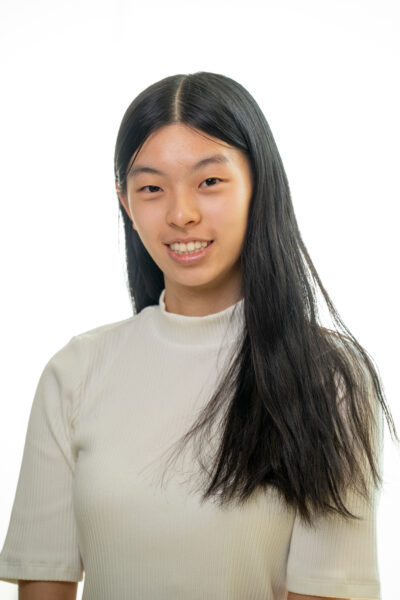
April Wang
She’s still deciding where her career will lead, but she knows what she wants to work on.
“I’d like to contribute to quantum computing algorithms and software for scientific applications,” she said.
Mu-Te Lau, a second-year PhD student, is headed in a similar direction in his career but points out that overcoming quantum’s hardware constraints requires engineering expertise.
“That intersection drew me in and is still what fuels my quantum compilation research,” Lau said. “I see my career in the layers between applications and quantum hardware.”
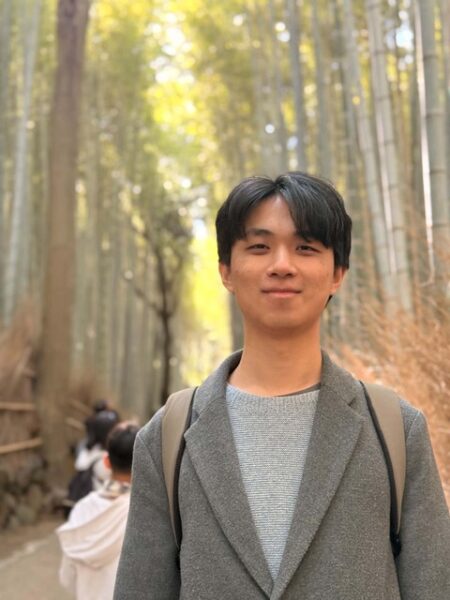
Mu-Te Lau
Looking ahead: from a blurry telescope to a sharp microscope
Hardavellas believes one of the biggest payoffs of quantum computing will be modeling nature itself. Classical computers struggle to simulate quantum systems, so scientists are forced to approximate. He compares classical computing to a telescope that produces a blurry image, and quantum computing to a highly accurate microscope that can model a physical system’s dynamics in full detail. That level of accuracy could eventually explain why a compound helps one patient but not another.
Interest from academia, government, national labs and industry is growing, and he wants Northwestern students ready to be productive in that space. The department is expanding its presence in quantum science and engineering, with faculty and postdoctoral positions currently open. It also seeks to develop partnerships with external apprenticeship and STEM training programs; for now, students find internships on their own, but a more structured path is on the wish list.
His message to students is straightforward: these courses are open to both undergraduates and graduate students, and the door is open now.
“Start with linear algebra, take a foundations course, and see where it leads.”