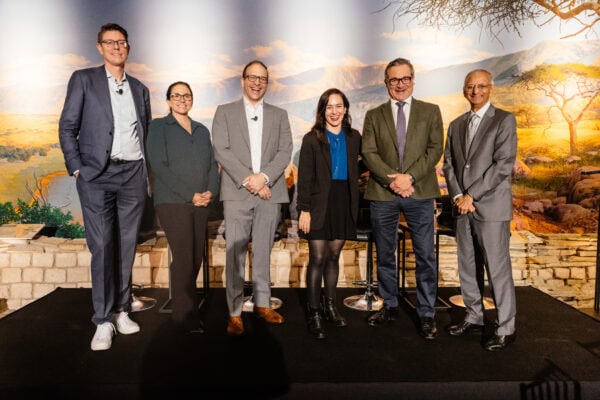
Brad Henderson, CEO, P33, with quantum panelists Katie Pizzolato, Vice President of Quantum Platform & Global Community at IBM; Field Museum researchers Dr. Philipp Heck and Dr. Sara Ruane, and Museum President Julian Siggers and Bobby Mehta, Museum Board Chairman.
Some of the biggest questions humans have ever asked — Where did we come from? How did the galaxy form? How did life evolve on Earth? — have long circulated between researchers and scientists in the world of natural history. Now, two Chicago research institutions — the Field Museum of Natural History and the Illinois Quantum and Microelectronics Park (IQMP) — are exploring what answers might be found if quantum computing is used to evaluate evidence older than Earth itself.
Field Museum researchers recently met with the IQMP’s National Quantum Algorithm Center (NQAC) and partners IBM, qBraid, PsiQuantum, Infleqtion and Classiq to explore a fundamental question: What are some of the hardest problems facing Field Museum scientists today? And could emerging quantum technologies eventually help solve them?
Three promising areas of study quickly emerged: the analysis of stardust, reconstruction of the tree of life and quantum biosensing.
Reading Stardust Without Destroying It
The Field Museum has spent more than 130 years building one of the world’s great scientific collections — nearly 40 million specimens and artifacts, and generations of research meant to help us better understand the galaxy and life on the planet.
Dr. Philipp Heck, Senior Director of the Negaunee Integrative Research Center and the Robert A. Pritzker Curator of Meteoritics and Polar Studies at the Field Museum, focuses on meteorites and the solar system. His research involves stardust, some of the most extraordinary and rare material in scientific discovery.
Stardust grains are solid minerals older than anything in our solar system, Heck explained during a panel at the museum’s Field Forward Symposium. They come from stars that lived and died before our Sun was born — stars that created the basic elements everything in the galaxy is made of.
“After traveling through the galaxy for billions of years, this stardust eventually reached the region where our solar system formed,” Heck said. “Planets, stars and the building blocks of life form from this material. Stardust is literally part of our origin story.”
However, studying stardust comes with a fundamental constraint: to answer key questions about where a grain came from, how old it is, what kind of star produced it, how long it traveled from its parent star to the solar system, and how the elements in it formed, scientists must consume part of the grain itself to measure its chemical composition.
“Once consumed, the grain is gone and cannot be studied further,” Heck said.
Spectroscopy — the technique of shining light on a material and reading what comes back — can reveal what a grain is made of without destroying it. But today, spectroscopy alone cannot answer all of the questions scientists most want to ask. This is where quantum computing enters the picture.
Quantum computers have the ability to predict what the light reflected from a given mineral should look like — which means they could help researchers extract far more information from spectroscopic data than is currently possible. Applied to stardust, that capability could allow scientists to determine grain ages and formation histories without consuming the sample, Heck said. With thousands of data points rather than a handful, researchers could analyze distributions across grains and begin to understand how the galaxy itself evolved over time.
Reconstructing the Tree of Life
In conversation with the NQAC, Dr. Sara Ruane, Associate Curator and Director of Core Labs at the Field, expressed interest in tackling a central challenge in modern biology: reconstructing evolutionary family trees at genomic scale.
The problem, she explained at the Symposium, is one of overwhelming complexity.
“Think of a combination lock. A lock with three numbers might take ten minutes to crack by trying combinations. Now imagine studying beetles — a group with roughly 400,000 known species — and working with the equivalent of 400 rotating numbers. The number of possible evolutionary trees becomes astronomically large.”
Using classical computers, researchers must rely on approximations and shortcuts to find the best answer they can. “That’s why these reconstructions are called ‘inferences,’ not answers,” Ruane said. “We can’t do this using classical computing — not with any real power.”
This is precisely the kind of problem that quantum computing may be well suited to address. Quantum optimization could potentially search across the space of possible evolutionary trees far more efficiently than classical computers — opening the door to more accurate reconstructions across larger datasets. For researchers struggling to fully analyze the genetic data they already have with classical computers, that would be transformative.
Ruane explained that the ambition extends beyond any single species group. “One of the exciting things about quantum is being able to reconstruct with accuracy the entire tree of life — all living organisms, together.”
Sensing the Natural World in New Ways
Field and NQAC researchers also talked about quantum approaches to a third frontier: quantum biosensing.
Museum researchers regularly work with tiny, degraded or difficult-to-access biological samples. Environmental DNA — genetic traces that organisms leave behind in soil, air and water — allows scientists to detect species and study ecosystems without ever collecting a physical specimen. More sensitive sensors could potentially help researchers extract useful information from even smaller amounts of material.
“Quantum-enhanced sensing could eventually offer researchers ways to extract more information from rare specimens while preserving them for future generations of scientists,” Heck said.
They also probed whether future quantum sensors could enable measurements closer to where biological processes actually occur — detecting chemical signals involved in interactions between insects and plants, for example — rather than requiring samples to be transported to a laboratory.
“One of the Field Museum’s strengths is using real-world examples to move beyond the hypothetical,” Ruane said. “Using empirical data sets from the museum’s collections is why the quantum meeting was so exciting. These data sets can ground quantum research in tangible, meaningful problems.”
The Urgency of Now
For Katie Pizzolato, Vice President of Quantum Platform & Global Community at IBM, who leads design and delivery of IBM’s quantum platform, the timing of these conversations matters.
”There will be a moment when we find the right algorithms for real problems and real data,” said Pizzolato.
Her advice to scientists and institutions: don’t wait for that moment to start preparing. The ramp-up is happening now. Gabriel Seidman, Executive Director, NQAC, says that’s where the NQAC can serve as a starting gate for institutions outside the quantum sector.
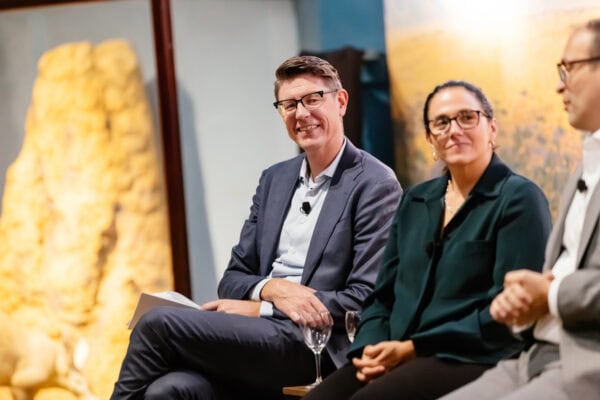
Brad Henderson, CEO of P33, led the discussion.
“Rather than starting with quantum technology and searching for a use case, NQAC can connect domain experts with the people and resources needed to determine where quantum could provide a meaningful advantage,” Seidman said.
The questions the Field Museum is already asking — about the origins of the solar system, the evolution of life and the chemistry of the natural world — are exactly the kinds of questions quantum technology was built to eventually address. This collaboration is about beginning to map where those two trajectories meet.
The next step is to translate those scientific challenges into specific computational and technical questions that quantum researchers can investigate more deeply.
Brad Henderson, CEO of P33, who moderated the quantum panel, said: “By connecting one of Chicago’s established scientific anchors with an emerging one, the relationship between the Field Museum and the IQMP offers a model for how the city’s existing strengths can connect with new technologies taking shape here and could give them entirely new ways to search for the answers.”