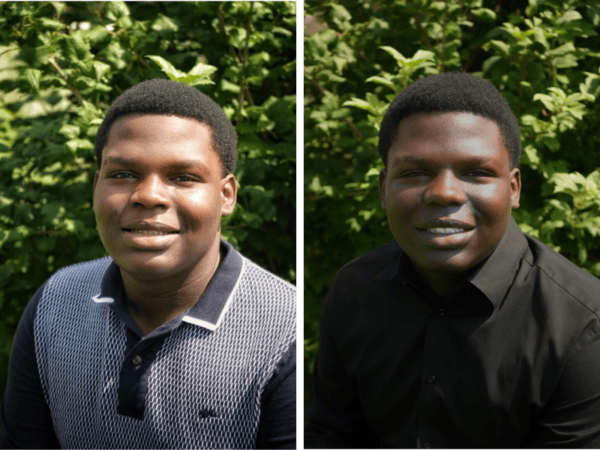
James Kountz (left) and John Kountz (right)
A year ago, James and John Kountz had never set foot in a quantum research lab. They had heard of quantum from their physics teacher, but it felt distant—even intimidating.
Today, the twin brothers from Chicago’s South Side are immersed in Illinois’ growing quantum ecosystem. They’ve attended so many quantum events that Governor JB Pritzker now recognizes them by sight and waved to them at the Saturday Morning Quantum* (SMQ*) graduation ceremony in April.
Through programs offered by partners of the Illinois Quantum and Microelectronics Park (IQMP)—from SMQ* and the Chicago Quantum Exchange to the Discovery Partners Institute’s Digital Scholars and Chicago State University—they discovered something unexpected: they belong in these spaces. That realization inspired them to transfer schools and pursue a degree in Engineering Physics at Chicago State University this fall.
As their quantum IQ develops, they are mentoring their peers and being recognized for innovative work, including their Digital Scholars capstone project: a smart walking cane prototype to help visually impaired people navigate.
Quantum 101
The twins’ introduction to quantum came sophomore year at Curie Metropolitan High School. Their physics teacher, Mr. Mitchell—a physicist—told them: “Once this comes out, this is going to be big. Just learn it with me.”
The message landed.
That early spark led the brothers to SMQ*, a 10-week program for 9th through 12th graders that brings Fermilab scientists into the community to teach quantum skills and careers through hands-on, interactive learning at Olive Harvey College’s South Chicago Campus. The program exposed them to real labs — including Fermilab in Batavia, Illinois — where they worked alongside scientists and engineers conducting active research.
“Learning directly from scientists, researchers and engineers was so awesome!” James said. “One thing I particularly liked was particle accelerations — hearing Fermilab scientists break down the steps of taking protons or electrons, making them travel close to the speed of light, and smashing them together to study how the universe works. It made the universe feel real and understandable.”
John remembered one moment at Fermilab that reframed everything for him: “The scientists would even tell us, ‘We don’t fully understand this either.’ That was powerful. It showed us that we could learn with them. We didn’t have to know everything to belong there.”
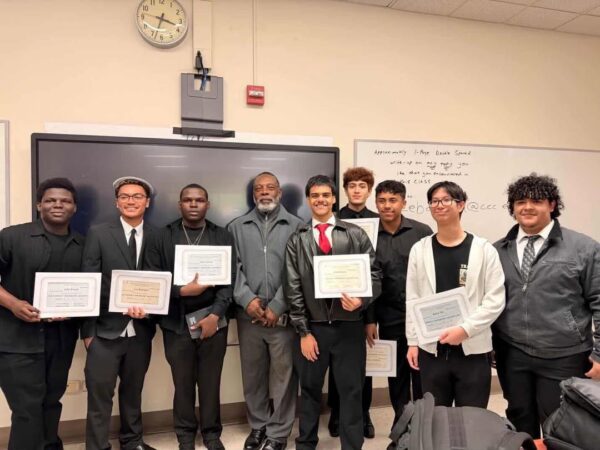
The Kountz brothers (first and third from the left) with fellow physics students at Curie Metropolitan High School.
Building a Community, One Opportunity at a Time
SMQ* became a launchpad. When the brothers attended World Quantum Day, they connected with the Chicago Quantum Exchange, participated in the OneQuantum symposium and started seeking out workshops and talks across the city.
“Quantum is a big community,” James said. “Once we got into it, people kept inviting us to more opportunities.”
One of those opportunities led them to Chicago State University, where Dr. Russell Ceballos was building QSTEAM, a quantum-focused STEM initiative. The chance to conduct research while remaining part of Illinois’ growing quantum community made the decision to enroll an easy one.
“We told them, ‘We’d love to do quantum research with you and stay in this community,’” John said. “That’s what really boosted the decision to choose CSU.”
Both brothers will begin their freshman year at CSU this fall. Over the summer, they sat in on Dr. Ceballos’s quantum physics course and conducted undergraduate research on quantum networks, encryption and cybersecurity. They also assisted Dr. Ceballos in demonstrating photon experiments on a full optics table to visiting high school students.
“Helping teach high school students felt like we had become scientists,” James said. “We told them, ‘If we can do this, y’all can do this.’ That was a great feeling.”
The Capstone That Connected Everything
This summer, James and John added another chapter to their journey through the Discovery Partners Institute’s Digital Scholars program at Harold Washington College. After six weeks of learning alongside 152 students, they debuted their capstone project: a smart walking cane.
Together, they built a device that uses ultrasonic wave sensors to detect nearby obstacles and alerts the user via a buzzer that beeps faster as objects get closer. They coded the prototype using an Arduino‑style kit – a small, beginner-friendly electronics board that allows you to connect physical components like sensors, buzzers and wires, and program them to interact with each other. They coded it in C++, which is an advanced, widely used language in engineering and systems programming. The project was selected for a special presentation at the conclusion of the program.
Even before the results came in, the brothers were thinking bigger.
“Everything we do, we try to add quantum to it,” John said, with James adding: “It’s become part of how we think.”
In conversation with Dr. Ceballos, they began imagining what the cane could become with photonics — the science of using light particles — integrated into the design.
“That’s the kind of leap quantum lets us dream about,” John said. “Not just helping people but potentially surpassing certain types of blindness.”
Rethinking What Quantum Is — and Who It’s For
Through their numerous quantum touch points over the past year, James and John have dismantled two big misconceptions:
- That quantum and AI will replace people
- That you must understand everything before you can participate
“Quantum is a tool — and we can shape how it’s used,” James said. “Instead of thinking, ‘What if quantum takes my job?’ start thinking, ‘How can we use quantum to protect people’s data, help people see and solve real‑world problems?’ That shift changed everything for us.”
Today, their biggest fascinations are quantum networks and encryption. John particularly sees urgency and opportunity.
“If we can use quantum to create unbreakable encryption, we can completely change cybersecurity. Our banking, our personal data — everything could be safer. And if our generation doesn’t build it, someone else will. We want to be the ones leading that work.”
Mentors Who Open Doors — And Don’t Let Them Close
Throughout their journey, mentors have been critical — especially Dr. Ceballos.
“This summer, we’ve basically been living science — living quantum — every chance we get,” John said. “Dr. Ceballos has made sure we’re connecting with the right people, building the math skills we need and getting research experience early. He always reminds us that if we come across something we haven’t seen before, it doesn’t mean we don’t belong. It just means we haven’t learned it yet.”
Quantum Ambassadors
For James and John, the next step isn’t just advancing their own careers. It’s bringing more people from their community into the work.
John: “I want people to feel like they belong in this space. When I felt out of place at my first college choice, I realized the environment matters. I want to help other people get to where I am — not feel like outsiders.”
Looking back, they trace everything to one decision.
“SMQ* is honestly the best thing we’ve ever done,” John said. “It opened the door to everything that came after.”
“And we’re just getting started,” James added.