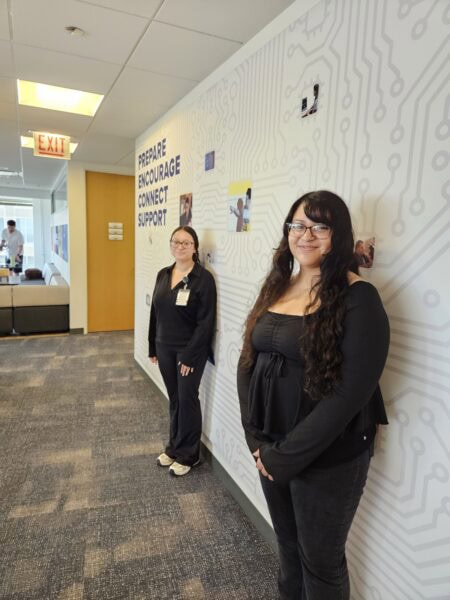
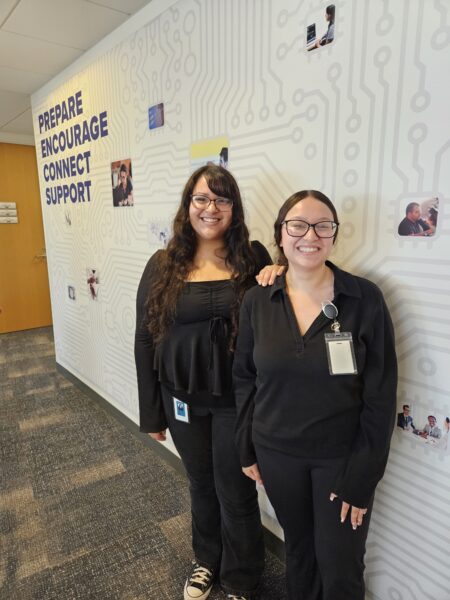
Alizah (left) and Nerida Coronado.
When sisters Alizah Coronado, 18, and Nerida Coronado, 17, first signed up for Fermilab’s Saturday Morning Quantum* (SMQ*) program, they had no idea where it would lead. The Carver Military Academy students—who will both be seniors this fall—entered the program knowing almost nothing about quantum computing.
Now, after completing SMQ* and spending the summer as interns at the Illinois Quantum and Microelectronics Park (IQMP), these South Side Chicago natives have gained a new appreciation for one of the world’s fastest-growing technologies. Along the way, they met researchers from diverse backgrounds, explored the growing quantum ecosystem and discovered that there are many ways to contribute to the field—even without becoming a scientist or engineer.
We sat down with Alizah and Nerida to talk about their internship, what they’ve learned about quantum and how the experience is shaping their futures.
Before this experience, how much did you know about quantum computing?
Alizah: Nothing. Everything was new to us, basically.
Nerida: Saturday Morning Quantum* was definitely a challenge. Some of the presentations went really in depth, and if you didn’t understand the Greek symbols or some of the physics concepts, it could be confusing. But once I started this internship, everything began to make more sense.
How would you describe quantum to someone who’s never heard of it?
Nerida: I would describe it as an advancement in technology. It’s not really a new topic, but it’s something people are still figuring out.
Alizah: I’d describe it as a way to create new technology and understand things better.
Has studying physics helped you understand quantum?
Nerida: Definitely. Physics is required at Carver, and now I recognize a lot of the same terms when we’re talking about quantum mechanics and quantum physics. It all makes a lot more sense now.
Alizah: I feel the same way. Learning physics has helped me understand the work we’re doing here.
What made you interested in quantum?
Nerida: What interests me most is that there’s still so much we don’t know. During Saturday Morning Quantum, I thought you had to become a scientist or engineer to be involved in quantum. Being here showed me that’s not true. We’ve met people from so many different career paths who are contributing to quantum. That made me realize I can still be involved without giving up the career I want.
Alizah: I already know I want to become a sonographer and work with expecting mothers, but if quantum becomes part of that field someday, I’d absolutely be interested in learning more.
How do you think quantum could impact healthcare?
Nerida: That’s one of the reasons I became more interested. I want to go into the medical field, and I like seeing how quantum could eventually be part of that. I think the combination of medicine and quantum is really exciting.
Alizah: If quantum could help find a cure for cancer, that would be amazing.
Nerida: I think about diseases in general. If quantum could help prevent diseases or find better treatments for things like cancer, that would be really important.
What have you been working on during your internship?
Alizah: We’ve been reviewing course catalogs from colleges in Illinois and Maryland to identify quantum-related courses. Each of us is reviewing five universities, and we’re looking through every course.
Nerida: We’re comparing programs to see how they’re similar and what topics are missing. We’ll present our findings at the end of the internship, and people have already been really interested in what we’re discovering.
What does a typical day look like at the IQMP?
Nerida: Most days we’re in the office working on our research, but we’ve also had opportunities to visit places like mHUB, and the IQMP construction site, too. It’s a nice balance between research and seeing what’s happening in the real world.
What has been the highlight of your internship?
Alizah: Meeting new people. We’ve gotten to visit different organizations, and everyone we’ve met is so passionate about what they do.
Nerida: I agree. It’s been interesting meeting people who didn’t necessarily start in quantum but found their way into it. That showed me there are a lot of different paths into this field.
What skills do you hope to take with you?
Nerida: I’ve learned so much science that I never would have learned otherwise. I also learned that good work takes time. Some days can be repetitive, but you’re still learning something new every day. That’s something I’ll remember when I get to college.
Alizah: Science and technology will definitely help me in my future career, even if I don’t work directly in quantum.
As Chicagoans, what does it mean to see the future of quantum being built in your city?
Alizah: I just want to see my city involved in things that help people. If quantum can help find cures for diseases or create new technologies that improve lives, that’s really important.
Nerida: I never realized what Chicago was capable of. I didn’t know about all the technology that has come from here. Seeing something as big as quantum being built in our city is really exciting. It’s made me see Chicago differently.