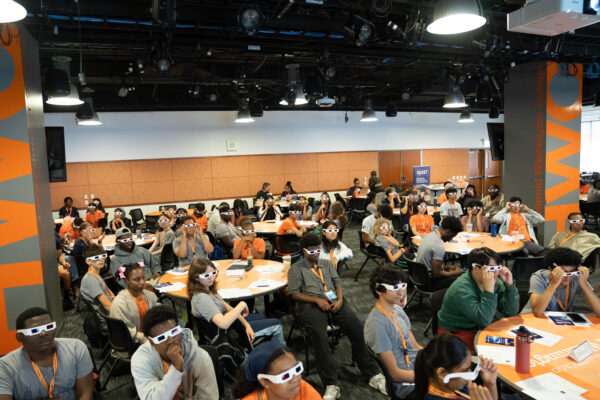
This summer, Discovery Partners Institute’s (DPI) Digital Scholars set up shop at Harold Washington College. For six weeks, classrooms buzzed with students building mobile apps, analyzing data, programming robots and pitching new ideas. The standout was a full-day exploration of quantum computing technologies. Organized with partners from the Illinois Quantum and Microelectronics Park’s (IQMP), students got a rare early look at one of the most exciting emerging fields in technology.
The Kountz brothers of Chicago’s South Side are already trying to figure out how to incorporate quantum into their capstone project—a smart walking cane for the visually impaired.
“As you get closer to a wall or an object, a wave detects it and triggers a sensor that makes the buzzer beep and send a warning signal,” said James Kountz, who attended the program with his twin brother, John. (Click here to read more about how James and John imagine using quantum technology to improve their inventions).
The twins were among 152 high school juniors and seniors and incoming college freshmen who were accepted into Digital Scholars—marking the largest cohort in the program’s seven-year history. Aligned with the Chicago Youth Works initiative, the intensive drew about 80 percent of its participants from Chicago Public Schools.
Program Coordinator Lindsey Vetvick attributes the spike in attendance to good word of mouth.
“Our students come from all different areas of technology and they’re starting to talk about their experiences in the program,” she said. “Schools, too, are starting to understand the work that we do. I think there’s a lot of interest in getting an opportunity to explore something new that they might not have access to at their schools.”
Digital Scholars not only introduces students to technology, it was designed to help them envision themselves actively shaping and leading the future tech economy. The program is built on three core pillars:
- Structured coursework in computing, data and engineering
- Weekly Friday workshops with guest speakers and hands‑on activities
- Community‑building that continues long after the program ends
Students chose one of five college-level tracks in computer science, electrical and computer engineering, data science and software development, and completed a capstone project tailored to their coursework. Projects ranged from mobile apps and data science research to assistive technologies like the Kountz brothers’ smart cane.
“Students can decide how they want to highlight the skills that they developed over the summer,” she said.
Changing How Students See Quantum
Every Friday, Digital Scholars participants took part in themed workshops featuring guest speakers that extended their learning beyond the classroom.
“Between the guest speakers, they get the chance to see what it’s like to study computer science and technology and work in industry — and they get to practice the skills,” Vetvick said. “It plants the seed: ‘I belong in this space.’ ”
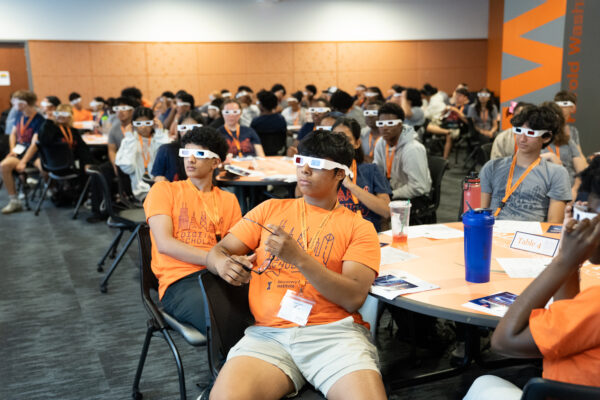
The day dedicated to quantum included:
- An introduction to basic quantum mechanics and real-world applications by Jaehoon Choi, a graduate student from the Illinois Quantum Information Science and Technology Center (IQUIST) at the University of Illinois Urbana-Champaign.
- A hands-on quantum cryptography activity developed with Argonne National Laboratory’s education team. Students first experienced standard encryption, then a modified activity designed to illustrate how quantum encryption works.
- A quantum careers panel, featuring Emily Easton, Director, Education and Workforce Programs at the Chicago Quantum Exchange; Mo Green, Head of Market Development and Community and Government Affairs at IQMP anchor tenant PsiQuantum; Caleb Williams, an undergraduate from the University of Illinois Chicago studying quantum, math and physics.
A Community That Keeps Going
Digital Scholars extends far beyond the six-week program. DPI staff maintain active relationships with graduates, sharing opportunities, internships and events. Alumni return as student coordinators, serving as near‑peer mentors rather than traditional staff, modeling what’s possible for participants just a few years behind them.
“We build community with them — not just track them,” said Kay Monelle, DPI’s Director of K-12 programs who has been with Digital Scholars since its inception in 2020. “We tell them, ‘No matter where you land, stay in connection with us. Build your network.’ ”
Each year, Digital Scholars aims to expand its impact — giving more young people the confidence and skills to define their own futures in technology, she said. From a cohort of about 20 students in its first year to 152 this summer, the program’s growth reflects real momentum, with more students seeing a pathway into high‑demand careers.
“That is wildly profound,” Monelle said, “and I love it.”